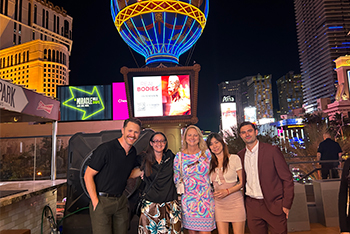
The Progressive Real Estate Partners (PREP) team just returned from the 2026 International Council of Shopping Centers (ICSC) conference in Las Vegas. Before this conference with 25,000 attendees even starts, the PREP team spends the day before attending events with 300+ fellow members of Retail Brokers Network (RBN).
RBN is comprised of approximately 60 offices and over 600 retail brokers from across the United States. PREP’s membership in RBN provides our clients with the high-quality boutique experience that PREP offers combined with a nationwide network of relationships to help serve our clients.
As you might imagine the combination of networking with RBN members and then ICSC members provided a dynamic experience for relationship building, deal making, knowledge acquisition and more. The following are our team’s takeaways from this year’s conference:
Relationships Are Still #1: A recurring theme is that despite artificial intelligence, retailer analytics, and other technological innovations, at its core, the industry is still “a relationship business.” Every lease and sale transaction involves a lot of risk mitigation. A substantial part of risk mitigation is knowing the people you are dealing with when trying to complete a transaction. Creating, building and fostering relationships is a massive benefit of attending the ICSC conference.
California is Persona Non Grata: Our team members spoke to every retailer that was exhibiting at ICSC and for those that are not already in California, the question was asked, “Are you looking to expand in CA” and they all said there were not looking to expand. The only exception were a couple of franchise concepts that indicated that if a specific large scale franchisee initiated the process, they would consider California.
Artificial Intelligence (AI) was Widely Discussed: I take a lot of pride in the fact that I believe the PREP team became curious about AI a lot quicker than many of our colleagues. As a result, we had many conversations to understand how AI is being utilized as well as what changes AI may bring to our industry.
Getting ideas to solve problems was a common theme regarding how to use AI. For example, if during due diligence the buyer’s consultants are making comments about an environmental issue, or the roof, or other technical systems, instead of having to call 3 professionals in that field to better understand the issue, we are finding that querying AI allows us to gain the knowledge to help the parties solve these issues.
Other examples of AI use include the following, but note that there are so many other ways people are using AI, but that is not the purpose of this blog:
- Research of individuals, companies, trade areas and similar in a much more efficient manner.
- Financial analysis. Not just crunching numbers and creating spreadsheets but helping to gain insights that one might not immediately see. For example, being able to quickly analyze and present the amount of square footage and rental amounts expiring based upon uploading a rent roll.
- Document review. For example, if you are looking for exclusive use language and the search finds the language, it is a lot easier than reading the entire document. But if the search does not come back with exclusive use language, then one can’t assume it isn’t there. Then a more detailed read is necessary.
There was a clear understanding that AI will change many aspects of the retail industry and there is a high curiosity level to understand what may be coming down the pipeline.
Caution About Consumer Spending & “The Economy”: Trying to understand which way the consumer is going is very challenging. It was noted that there are certainly different consumers that are being affected by rising fuel prices, modest job growth, housing costs, current interest rates, and so much more. It seems that “unpredictable” may have become what is predicable.
It’s About the Retailer and Not the Industry: In the past, it seems that one could make broad comments about overall industries like fitness, grocery, quick service restaurants, fast casual restaurants or full-service restaurants. But now it seems to be very retailer specific. Within most industries there are operators that are winning and those that are losing. Knowing which is which, is becoming more critical as landlords seek to lease to the “correct” operator.
Caffeine is King: For many years, in SoCal it was all about Starbucks. But now there are many coffee brands such as Dutch Bros., Black Rock, Better Buzz, 7 Leaves, Dunkin, Tierra Mia, and more. But there are also restaurants like Taco Bell and McDonalds that are upping their coffee game. It seems that when it comes to pad users, those that emphasize coffee are the most aggressive in making deals.
Deals Continue to Get Harder: There was a lot of discussion about the levels of corporate approvals and the length it is taking to get these approvals. Because there are very few retailers that feel a need to move fast to complete a transaction, many are moving at a much slower pace to complete a lease.
City Approvals Are Taking Longer: For most transactions the broker does not get paid their entire fee until the tenant is open for business. As a result, brokers are frequently tracking the process of tenants getting their approvals and then completing construction. There was a fair amount of complaining that everything is taking longer. Some of the reasons cited include less city staff, more rules & regulations, a longer construction bid process, tenants/developers waiting for each sequential step to happen to mitigate costs in case something goes wrong.