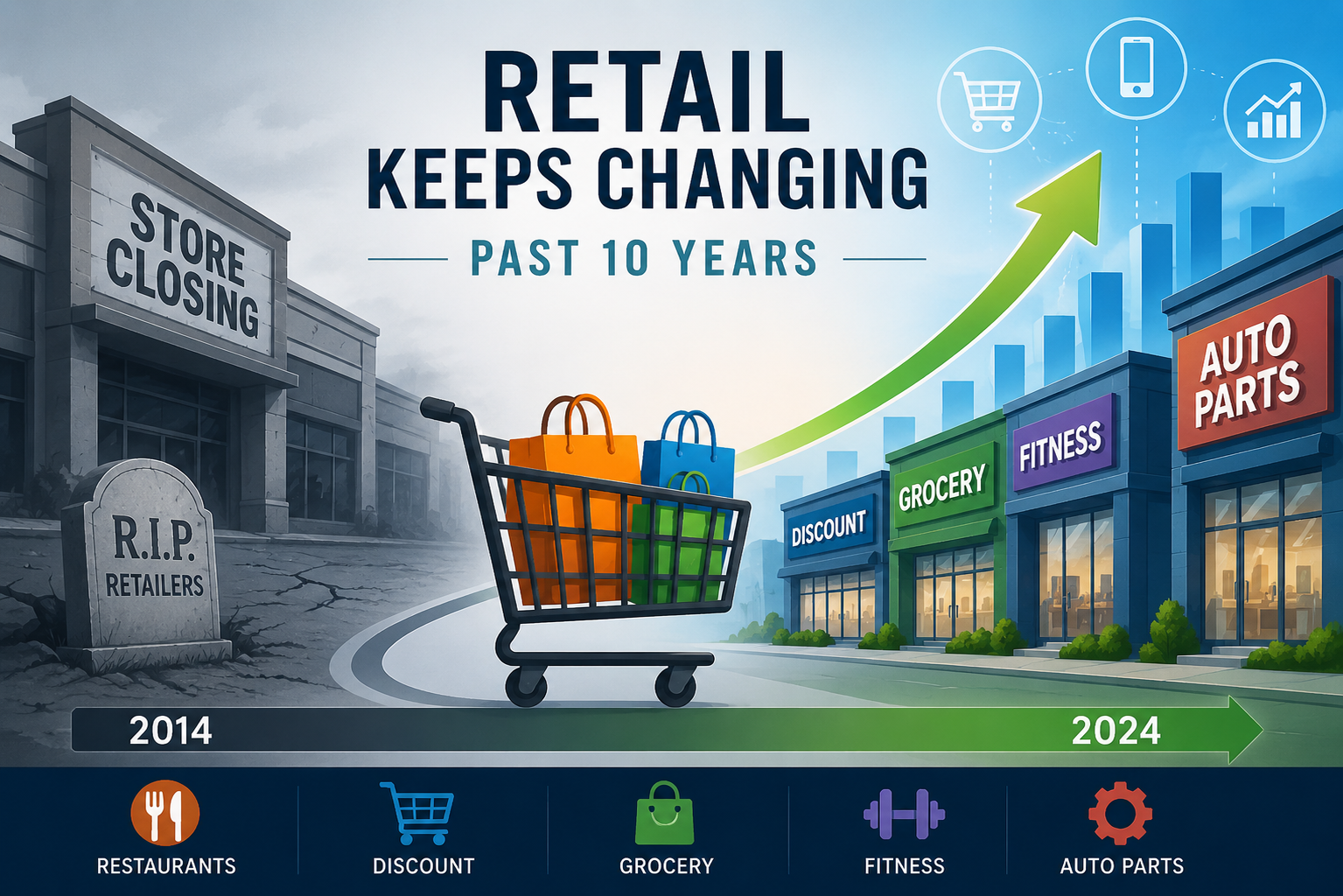
These are 3 things I can guarantee and to prove the latter, I took a look back at the last 10 years to see how the retail industry has changed. I will admit that I could not have done this without my friends ChatGPT and Claude.ai who did a lot of the deep research for me as well as prepared the graphics. In addition to demonstrating that retail has changed a lot over the past 10 years, it also demonstrates that one of the keys to AI is knowing which questions to ask, how to ask them, and then how to cater the output to your audience. I hope I have done so.
Also, note that my focus was on Southern California’s retail industry. As a result, if a retailer is not doing business in SoCal, their information was likely omitted from this blog.
Who Opened the Most Stores in the Past Decade
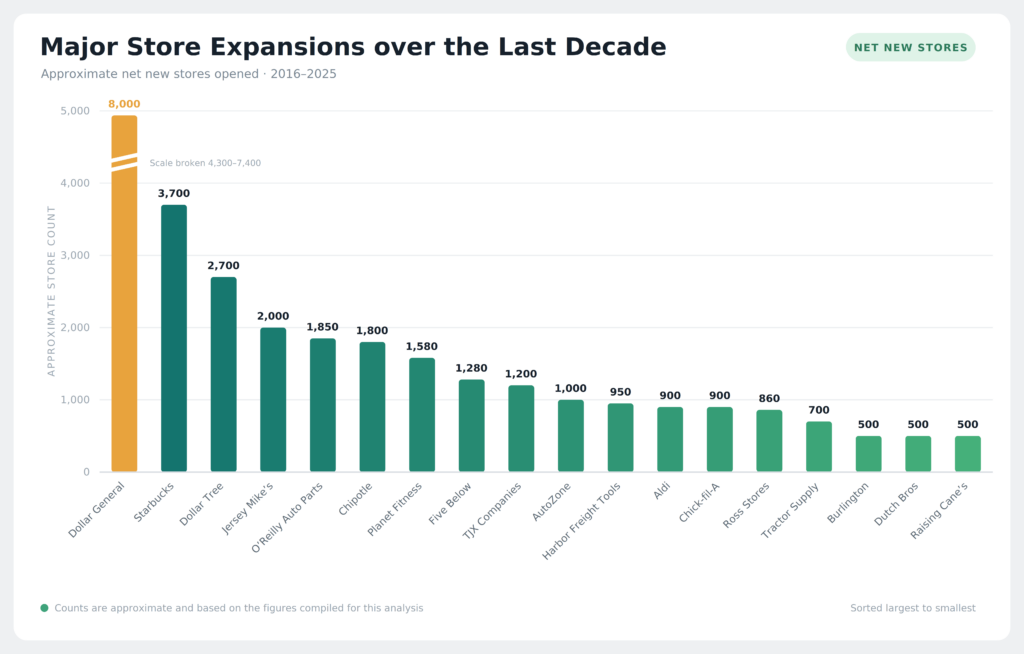
Restaurants: The most active restaurant concepts were Starbucks, Wingstop, Jersey Mike’s, Chipotle, Crumbl, Chick Fil-A, Dutch Bros., Raising Cane’s, and Shake Shack which each added over 500 stores and collectively added over 13,200 locations.
Dollar Stores: The retailer that has added the most stores has been Dollar General with over 8,000 new stores! Their main competitor, Dollar Tree (which now owns both the Dollar Tree and Family Dollar brands combined to add 2,700 new stores). Together these three brands have over 37,000 stores throughout the United States.
Discount Soft Goods: These retailers have exploded in growth over the past decade with Ross (Ross & dd’s), TJX (T.J. Maxx, Marshalls, HomeGoods, Sierra) and Burlington opening a new 2,500 stores during the past decade.
Auto Parts: The combination of AutoZone and O’Reilly Auto Parts has yielded over 2,850 new locations over the last 10 years.
Fitness: This buff category included Planet Fitness adding over 1,500 units, Orange Theory over 1,000 units, Club Pilates adding 960 units, Anytime Fitness over 600 and Crunch over 300.
Grocery: The Grocery industry changed dramatically over the past 10 years with Costco, Aldi, Sprouts, Grocery Outlet, and Trader Joe’s opening over 1,600 stores which combine for over 40M of net square footage leased by these grocery operators.
Others: Harbor Freight Tools, Tractor Supply, and Floor & Décor are retailers that most of us in SoCal had never heard of in 2016 and they collectively added over 1,800 stores throughout the country.
The Stock Market Winners
Although many wished we had a purely tech portfolio during the past decade, there were some big winners in the retail category. The following represents the top 15 retailers including the amount that exceeded the 10 year return of the S&P 500 during this period of time.
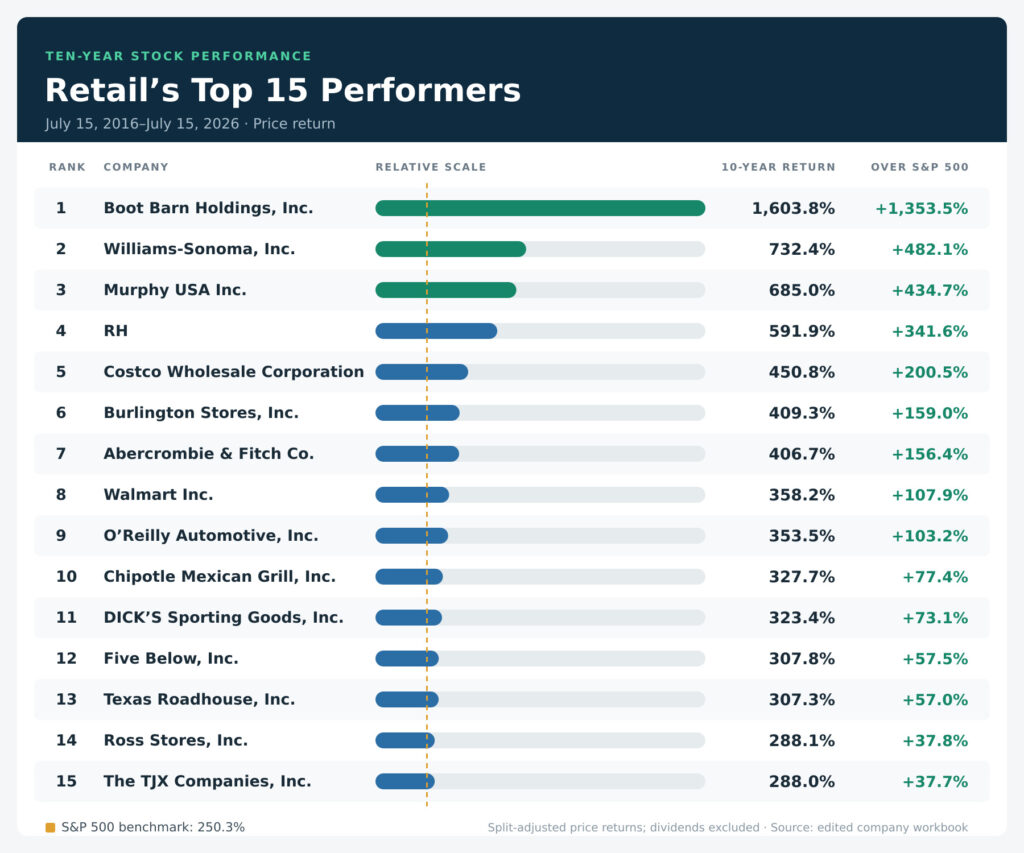
It is worth noting that only about 20% of “retail” publicly traded companies beat the S&P 500 over the past decade.
The Retail Graveyard
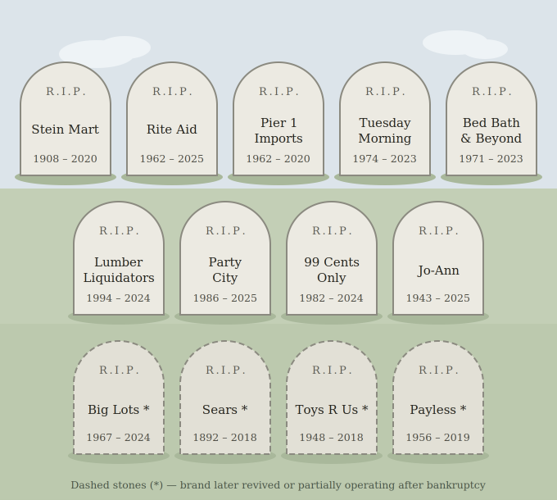
It would be unfair to display a list of poor stock performers over the past decade because to be included in this list, at list the company is still in business. Instead, the following represents what I believe are the most impactful liquidations of the past decade.
The Disappearing Act – Retailers that Have Gone Private
An investor buys a retail property knowing that its tenant is a publicly traded company. This was a material reason for the purchase because it allowed the investor to continuously monitor the financial health of the company. Then POOF, the company goes private and access to financials become non-existent.
As private equity has grown over the past decade, we have seen more operators go private making it much more difficult to monitor their financial health. On one hand, this could be good because now the retailer isn’t at the whims of quarterly results which could allow for a much greater investment in store renovations. On the other hand, these private equity acquisitions frequently result in a substantial amount of debt leveraged against the company making the retailer much less nimble in case of shifts in the marketplace (or a global pandemic!).
The following is a list of some of the key retailers that have “disappeared from the public markets: Walgreens, Whole Foods, Smart & Final, Panera Bread, Buffalo Wild Wings, Jamba, Sonic, Bojangles, Famous Dave’s, Barnes & Noble, Vitamin Shoppe, Michaels, Hibbett, Nordstrom, Big 5 Sporting Goods, and David’s Bridal.
Conclusion
Bottom line: retail did not stand still during the past decade, and it will not stand still during the next one. It made sense that some retailers experienced explosive growth while others collapsed, but there were certainly some surprises.
I am not sure if I had even heard of Tractor Supply, Five Below, or Aldi ten years ago. I certainly had not heard of Crumbl Cookies or Dave’s Hot Chicken because they did not even exist. And then there were stores that I thought would live forever such as Party City and Toys R Us. I think the lesson is that retail is always changing and it is critical to keep up with the trends.
At Progressive Real Estate Partners, we enjoy helping Southern California and Inland Empire owners think through these shifts and position their properties for the long term. Please contact us to discuss any of your retail needs.
Finally, if you want to offer who you think may appear on the top or bottom of these lists if I were to be writing this blog 10 years from now, I would love to hear what you think.