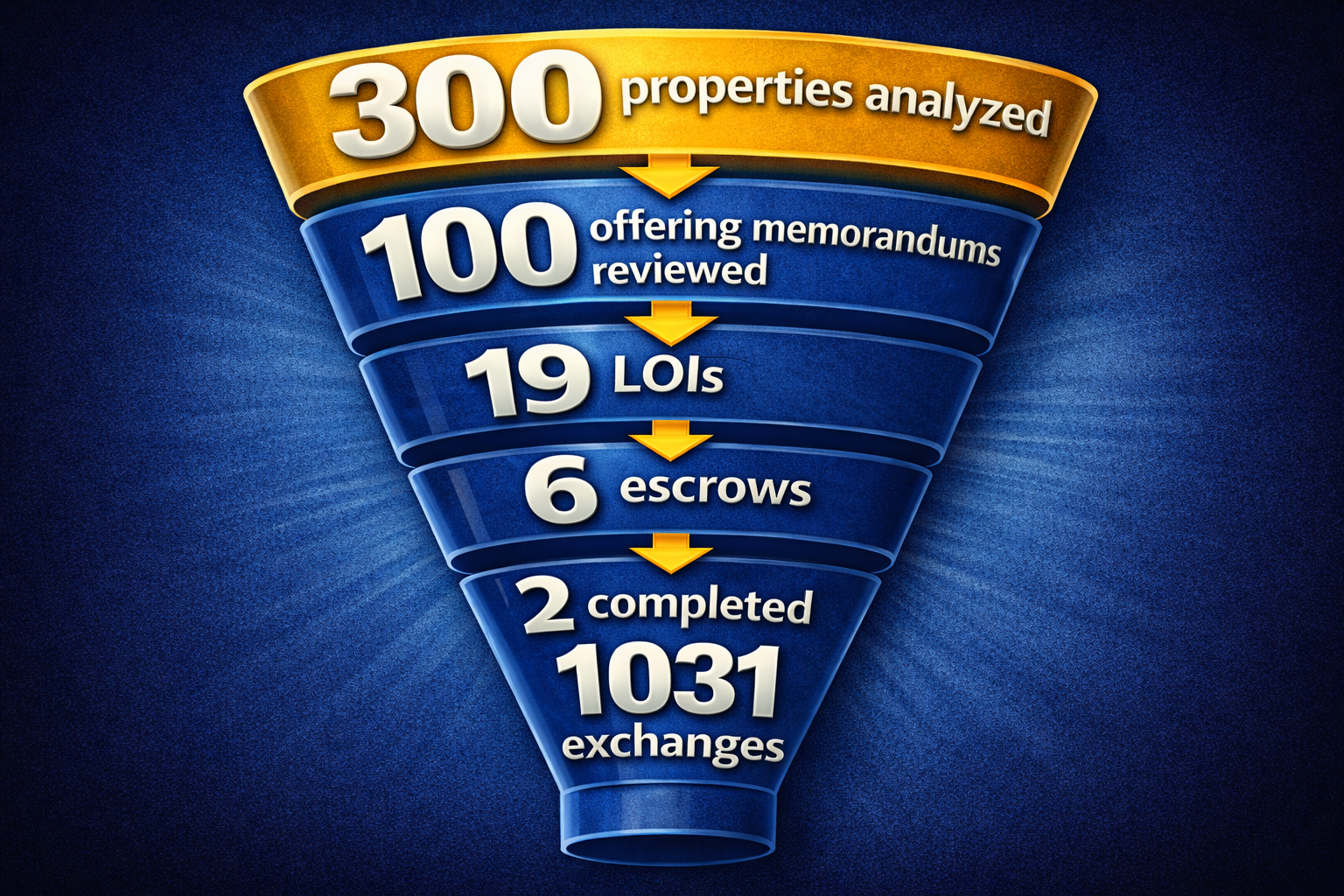
- 300 properties initially analyzed
- 100 offering memorandums reviewed in detail
- 19 LOIs
- 6 escrows
- 2 completed 1031 exchanges
Progressive Real Estate Partners frequently helps clients with their 1031 exchange including representing owners that retain our services to sell to then help them buy a replacement property.
I recently had the opportunity to represent two long‑term clients in the execution of their 1031 exchanges. The above funnel is what it took to get to those two closings.
Exchanger A was seeking a multi‑tenant retail property in Southern California. They were highly experienced and wanted a quality trade area, a diversified income stream, and the potential for long‑term growth. They closed all‑cash and plan to add modest financing after closing. Maximizing current income was a consideration, but not the top priority; preservation of equity was the priority.
Exchanger B was seeking an absolute triple‑net property in a right‑leaning state with zero to modest personal income tax. Their priority was maximizing income while mitigating as much risk as possible. Because of the structure of the partnership, there was very little flexibility to add new equity. The target price was $3.5M, so a property at $3.5M with a slightly lower cap rate than one at $3.2M could still be more desirable because it created more income and helped avoid taxable boot, which was also an objective.
While these deals are fresh in my mind, here are lessons learned from these exchanges and from others I have worked on over the years.
Lesson 1 – Start Early
In both exchanges, we began making offers when we were confident that the buyer of the downleg (the property my client was selling) was going to waive contingencies. We became more aggressive once that buyer waived contingencies.
In one deal, we negotiated a 45‑day closing after the downleg buyer waived contingencies, even though they were paying all cash. This gave us 45 days plus the 45‑day identification period to find and identify the upleg properties (the properties my client was going to buy). Our goal was to close on the upleg before the end of the 45‑day identification period to eliminate as much risk as possible.
Lesson 2 – Use a Local Attorney
I cannot overstate the importance of using an attorney based in the state where you are buying.
Exchanger B had agreed upon a deal to buy a newly constructed property in Arizona. Because we used an Arizona‑based attorney, she advised us about a tax we had never heard of known as “a speculative builder/city transaction privilege tax” that the seller was obligated to pay if they sold the property within two years after substantial completion. (Please do not rely on this blog for exact legal interpretation.) If the seller did not pay, the obligation could become a lien on the property and create an obligation of the buyer.
The seller was an out‑of‑state LLC formed to develop this one property, so my client and I agreed there was too much risk. The tax on this property would have been at least $70,000. Although we do not know how this exactly would have played out, when you are in a 1031 exchange you don’t have time to figure out these types of oddities.
We also considered properties in Florida and North Carolina. Each state handles escrows, titles, deeds, and related items differently, and having legal relationships in each state through our affiliation with Retail Brokers Network was a huge benefit to our client.
Lesson 3 – Be Skeptical of Listing Brokers and Sellers
I hate to make this statement, but it is especially true in the single‑tenant net‑lease world: you must be skeptical of listing brokers and sellers. Most single‑tenant net‑lease brokers have never visited the property. Many are early in their careers and simply do not know what they do not know. Sellers, especially developers, tend to hope for the buyer that is naïve/ignorant and they want to brush any issues that are found by the buyer under the rug and hope that these issues would go away. We had multiple deals where this occurred and only when we pushed and made it clear that the deal would not close unless they addressed our issues did they get serious about answering the questions.
In one deal, we discovered that the tenant had a Right of First Refusal only after we were under contract and reviewing the lease. When we confronted the broker, he said the developer “forgot.” Personally, I believe the developer knew and the broker may have known, but they decided to withhold the information.
In another deal, we were told that roof and parking lot repairs flagged in the property‑condition report (which we gave to the seller to address) had already been completed. The day after that statement, I visited the property and confirmed the work had not been done.
These are just a few examples of issues we encountered along the way.
Lesson 4 – Visit the Real Estate
I beg all buyers: go see the property—ideally before going under contract, but certainly no later than during due diligence. There is only so much you can figure out from your laptop. It is very difficult to see grade differentials, vacant buildings in the trade area (especially ones that just occurred), what the surrounding neighborhoods look like, and much more.
Exchanger B had a property under contract in a blue‑collar trade area. The buyer struck up a conversation with the security guard, who described recent shootings, robberies, and more. That ended our interest. Fortunately, this was a backup property, so it simply made the primary deal look even better.
Lesson 5 – Do Not Put Your Eggs in One Basket
It was a tremendous amount of extra work to have multiple LOIs, PSA negotiations, and escrows going at one time. Unfortunately, that is the reality: issues come up in deals, and a prudent 1031 buyer will juggle more than one property, especially as the decision deadline approaches.
As someone who has been a listing broker for most of my career, it was painful to tell listing brokers that my client would not be moving forward with their property. But that is part of protecting the exchanger.
In my experience, until you are deep into due diligence you likely don’t know whether a property has significant issues. There are so many I’s to dot and t’s to cross. For me, the initial round of due diligence is looking for reasons not to buy a property. But then if you end up with two properties that pass the “it could work test” the focus shifts to which is the best property to buy.
It is good to have choices.
Lesson 6 – Do Not Burn Bridges
In the case of Exchanger A, they ultimately bought a deal they had previously terminated. Terminating the initial escrow was difficult because I really liked the listing broker and thought he did quality work.
We were on the fence between two deals—one in North Carolina and one in Florida. We had one major issue to resolve on the Florida deal and had been assured by the listing broker and developer that the tenant had agreed to fix it. After we cancelled the North Carolina deal, the Florida issue could not be resolved. We decided that “the devil we knew” in North Carolina was better than waiting and hoping the Florida issue could be resolved.
Because we treated the North Carolina seller and broker respectfully, and because they genuinely wanted to sell the property, we were able to reinstate the escrow and close.
Lesson 7 – Pick Your Broker Carefully and Then Be Loyal
Proper representation of a buyer consumes a lot of energy. If you are loyal to your broker, they can give you 100% effort; if you are not, you will likely get 50%, and then you get the property you end up with.
The broker who sells your downleg is frequently the broker many buyers use on the upleg, but a good listing broker is not necessarily a good buyer’s broker. For most of my career, I focused on listings and had little interest in representing buyers because it took so much away from my listing business. As I became more relationship‑oriented later in my career, I did more buyer representation.
This is a sensitive topic that requires good communication between the 1031 buyer and broker. There must be a clear understanding of what the broker will do, and the broker must actually do it. If you want to talk about this, call or email me.
Lesson 8 – The Tools to Evaluate Deals Today Are Unbelievable
Here is a list of some of the tools we used to analyze deals in these exchanges:
- Placer.ai – If you are unfamiliar with this program or similar tools, become familiar quickly. Placer.ai uses mobile data to estimate the number of visitors to a site, and it is reasonable to assume that sales correlate with visitors. I am convinced we now live in a world of brokers/investors who either have this tool or do not. When I evaluated single‑tenant deals for Exchanger A, once a deal looked viable, I ran a Placer.ai report; if the site was in the bottom 25%, our interest ended. Many deals that looked good on paper turned out to be in the bottom 5%. Even if the Placer data is imperfect, why take the chance? As I have stated, when you are in a 1031 exchange, it is about finding qualifying properties quickly and not getting hung up with “maybe” properties.
- CoStar – This was my primary tool for locating properties. I also used it to infer market rents. For example, if you look at all Starbucks locations built and sold in Florida since 2020 and multiply the cap rate by the sale price, you can approximate the rental rate. You can then compare that to the property you are evaluating to see whether the tenant is paying significantly above or below what Starbucks typically pays in that market. This can help determine whether the deal you are buying has over or under market rents.
- Demographic data and crime reports – There is a huge amount of demographic data available to help you understand a trade area. Listing brokers often use 1‑, 3‑, and 5‑mile rings in their offering memorandums, but for fast‑food tenants, 5‑, 7‑, and 10‑minute drive times are often more relevant because almost no one drives more than 5–7 minutes for fast food. You also need to understand whether the trade area has the right mix of income and ethnicity for the concept. In one deal, we could not get comfortable because the average household income in the trade area was $200,000/household. Our gut told us that households at that income level were unlikely to patronize that particular concept.
- AI programs such as ChatGPT or Perplexity – The amount of information you can gather about a trade area, a tenant, or an industry is mind‑blowing. I recommend asking the same questions in multiple AI programs to see if you get similar answers. This information is still evolving, so keep your skeptical hat on, read carefully, and verify when possible.
- Airtable – This is a great program for tracking all the deals a broker and buyer look at. It quickly becomes impossible to remember every property, what you concluded, and why. A deal that was not compelling early in the process may become “good enough” as options narrow. Airtable helps you keep that history organized.
Lesson 9 – Do Your Third‑Party Reports Immediately
In a 1031 exchange, time is your enemy. The buyer must be prepared to spend $5,000–$10,000 per site for a physical inspection by a professional inspector, a Phase I environmental report, and possibly a survey immediately upon signing the PSA. Both of my clients understood this and were on board.
For Exchanger B, on one multi‑tenant building we put under contract, we found a bush growing on the roof. That was one of many issues the inspection revealed, including significant ADA issues we had not focused on when we first viewed the property. If there are any environmental concerns, the Phase I will surface them—and there simply is not enough time in a 1031 exchange to resolve serious environmental issues.
I also believe in ordering surveys. For most smaller properties, they generally cost no more than about $2,500 and can be very helpful in identifying issues. Make sure to ask the surveyor what issues they observed or did not observe. Assuming you close, the survey can also become a very useful future management tool.
Lesson 10 – New Construction Has Issues Too
On the surface, buying a newly constructed building seems ideal: it is brand‑new, so there should be no problems. In practice, we encountered several obstacles. These can be overcome, especially if the developer/seller is reputable, but they must be understood.
- No operating track record – Placer.ai cannot provide information for a location that has not opened. Even if it has been open a few months, that is still a weak predictor of long‑term success.
- Potential liens – Again, this is where a local attorney is critical. You must understand what happens if the seller or tenant does not fully pay their contractors and how long those parties have to file a lien against the property. Each state—and sometimes local jurisdictions—has different lien laws.
- No time for problems to emerge – If the developer built the building, no time has passed to see whether there are structural issues. Even on a ground lease, soil and drainage problems may be the property owner’s responsibility.
- Potential lease issues – In one deal Exchanger A almost bought, it was a ground lease, but the lease said that if the building was destroyed prior to rent commencement (opening for business), the tenant could terminate. We could not rely on this property as an upleg until they opened. The OM said they would open in October; then it was pushed to November, then to December. They finally opened mid‑December. Ultimately, we cancelled this deal, and this issue was part of the reason.
Lesson 11 – Work with a Very Reputable Mortgage Professional
Both of my clients purchased all cash. But I have been involved in plenty of 1031 exchanges where the buyer utilized debt. My number one recommendation is that a buyer should utilize a mortgage professional and make sure they are evaluating early each property in which you are negotiating an LOI from a financing perspective. The debt markets are very fickle and it is taking longer and longer to determine what type of debt and what issues related to the debt may come up regarding each property.
Many buyers bank with one of the large financial institutions like Wells Fargo or Bank of America and they get assured by someone at the local level that they will be able to provide debt for their client’s acquisition only to find out that because of the specific property that the buyer wants to purchase, the terms they can provide are not favorable. A 1031 buyer cannot afford to waste time and over and over again, I have been surprised by the unique lenders that exist all across the country that the financial professionals I have worked with pull out of their hat to help us close deals.
Conclusion
For most individuals, a 1031 exchange is not just a tax strategy. It is a decision about where you will reinvest a meaningful portion of your net worth for many years. The investors who tend to be most successful are the ones who start early, surround themselves with the right team (local attorney, seasoned mortgage professional, and a broker who will tell them what they need to hear, not what they want to hear), insist on seeing the real estate, and are willing to walk away—even late in the process—when something does not feel right. They leverage data, technology, and third‑party reports to screen quickly, but they also listen to their gut, the stories they hear on the ground, and the patterns they observe across multiple deals. My hope in sharing these lessons is not to scare you away from doing a 1031 exchange, but to encourage you to approach it with eyes wide open, a healthy dose of skepticism. If you take nothing else from this article, let it be this: assemble a trusted team, give them enough time to do their job, and remain disciplined enough to say “no” until you find the one property that truly deserves your “yes.”